
Clermont Projected and Actual Dates
Ohio’s public state-prison label is “Expected Release Date/Parole Eligibility Date.” It can represent a projected release date or a date tied to parole consideration. It is not always a promised prison exit. The same ODRC record can retain a future expected date while Current Status says Released through judicial release.
Actual release is a custody event. For Clermont County Jail, the strongest record is the maintained release timestamp and release or transfer code, paired with the court order. For ODRC, current status, release detail, and supervision start date are stronger than an expected date alone. A transfer from Clermont County Jail to state prison is not community release.
A pretrial detainee presents a different question. No imposed prison term exists to calculate. Bond, dismissal, plea, sentence, other holds, and court orders can change the outcome. The Municipal or Common Pleas docket and the jail record are the correct sources.
A roster bond amount also is not a countdown. It records a court or custody field, not payment or completed release. Another case or outside holder may keep the person confined after one bond is met. Confirm the latest order and the full hold picture.
Find a Clermont Release Date
Start with the last custody system. ODRC does not calculate every county jail departure. The county roster also does not show projected or actual release dates. It is current-custody data with booking, charge, court, case, and bond fields.
- Determine whether the person is pretrial at Clermont County Jail, serving a local jail sentence, or in an Ohio prison.
- For an Ohio prisoner, open the ODRC Offender Search. Search by offender number or by last and first name with few filters.
- Use County of Commitment = Clermont to narrow a Clermont sentence. Do not use Residential County for an incarcerated person.
- Open the matching detail and read Current Status first. Then review aggregate sentence, jail-time credit, sentence type, release detail, and Expected Release Date/Parole Eligibility Date.
- For a local jail sentence, read the sentencing entry, credited days, concurrent or consecutive terms, holds, and later court orders. Ask sheriff records for maintained calculation or release data.
- Confirm an actual exit through the custody agency. If exact local time or destination matters, request the booking-release record.
The full Clermont County released-inmate search explains how to reconcile the roster, court docket, VINE, and a records response.
The ODRC search is the official public route for a Clermont-sentenced state prisoner.
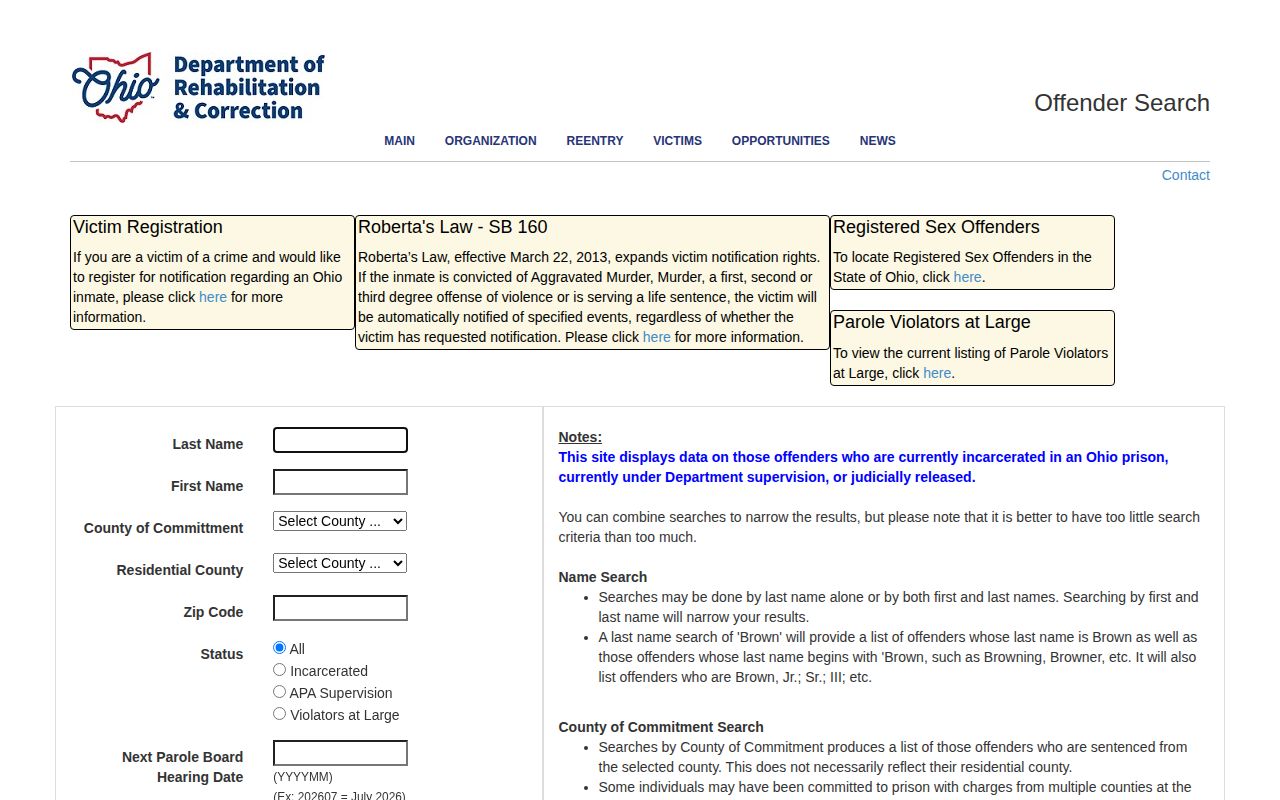
Its record must be read by status and sentence fields together, not by one date in isolation.
Ohio Credit in Clermont Dates
ORC 2967.194 supplies the current earned-credit framework for qualifying confinement on or after April 4, 2024. Eligible people may provisionally earn one or five days per completed month for productive participation, based on the statutory category. Up to five added days may follow completion of a second qualifying program or activity. Certain listed completions can produce a separate credit of ninety days or ten percent of the stated term, whichever is less, subject to exclusions.
Ordinary aggregate participation and completion credit under division (A)(4) is capped at fifteen percent of the stated term. Credit can be denied or withdrawn after rule violations. Eligibility is not universal. Listed exclusions cover specified mandatory terms and several sentence or offense classes.
Sentence era also matters. ORC 2967.193 covers the prior period, while division (G) of the current law separates confinement before and after its effective date. OAC 5120-2-03.2 distinguishes pre-SB2, SB2, HB86, and SB201 computations. A current ODRC detail is safer than applying one formula to every sentence.
Jail-time credit is another input. Under ORC 2967.191, qualifying confinement reduces the proper sentence based on the sentencing court’s determination. A correction to jail credit can therefore change a calculated date. It does not convert an expected date into proof of actual release.
Why Clermont Release Dates Change
A projected date changes when one of the legal or custody inputs changes. The reason should be tied to a record, not guessed from a roster disappearance or stale display.
| Factor | Possible effect | Best source |
|---|---|---|
| Jail-time credit correction | Moves the sentence calculation | Sentencing entry and ODRC detail |
| Earned credit earned, denied, or withdrawn | May reduce or restore time within governing limits | ODRC record and current statute |
| Concurrent or consecutive terms | Changes aggregate sentence length | Judgment entry and aggregate sentence |
| Parole action | Can grant, defer, deny, continue, or rescind a projected release | Parole Board result and current status |
| Judicial release | May produce release before the earlier expected date | Court order and ODRC released status |
| Detainer or outside hold | May cause transfer to another custodian | Release record and receiving authority |
| Indefinite-term review | Can alter actual timing within the sentence framework | ODRC detail and Board record |
Parole eligibility also differs from a fixed exit. A Next Parole Board Hearing/Review Month is a scheduling field. ODRC definitions note that review can occur before the displayed month. A “paroled” result alone does not prove physical release; current status and supervision start or release detail must agree.
Note: An outside hold can turn a jail departure into transfer, so the receiving authority matters as much as the timestamp.
Confirm Clermont Actual Release
For a recent county custody change, the sheriff directs release-notification questions to VINE. A Clermont County VINELink check can supply a recent status and alert. It is not a legal disposition record. Confirm with the reporting facility and read the court docket.
For exact local details, request the existing booking and release record. Identify the person, booking number if known, and a narrow date range. Ask for admission and release times, release or disposition code, releasing authority, receiving agency, and holds shown at release. If a code is unclear, ask for an existing code table rather than an interpretation created for the request.
For ODRC, read Status, release detail, and supervision fields. APA Supervision confirms that the person is outside prison under department oversight as of the record date. It does not mean the whole sentence or all conditions ended. If the detail says Released or Judicial Release but retains a future expected date, explain both fields instead of reporting continued incarceration.
ODRC uses several other date labels. Earliest Possible Transfer Date refers to potential transitional control, not ordinary release. Next Parole Board Hearing/Review Month is a schedule field. Supervision Start Date can support prison exit when it agrees with status, while Supervision End or Expiration marks a later milestone. None should be silently renamed actual release date.
When no online result appears, retry variant names and less search criteria. Then use the case number and agency contact. Sealed records, juvenile restrictions, data age, another county, and an unsearched custody system can all explain absence. “No online result found” is the safe conclusion until an agency supplies more.
No Universal Ohio 85 Percent
The claim that every Ohio prisoner serves eighty-five percent is not supported. The fifteen-percent ceiling in the current statute applies to eligible ordinary earned credit within one part of a wider framework. Mandatory and nonreducible terms, excluded offenses, special completion credits, sentence era, indefinite terms, judicial release, parole, and other provisions can produce different results.
A sound calculation starts with the judgment entry and ODRC aggregate sentence. Add the court’s jail-time credit, identify concurrent or consecutive terms, and apply the credit law for that sentence and confinement period. Do not subtract a flat percentage. The public detail reflects inputs that may not all appear on one screen.
The official current Ohio earned-credit law shows both the credit structure and its exclusions.
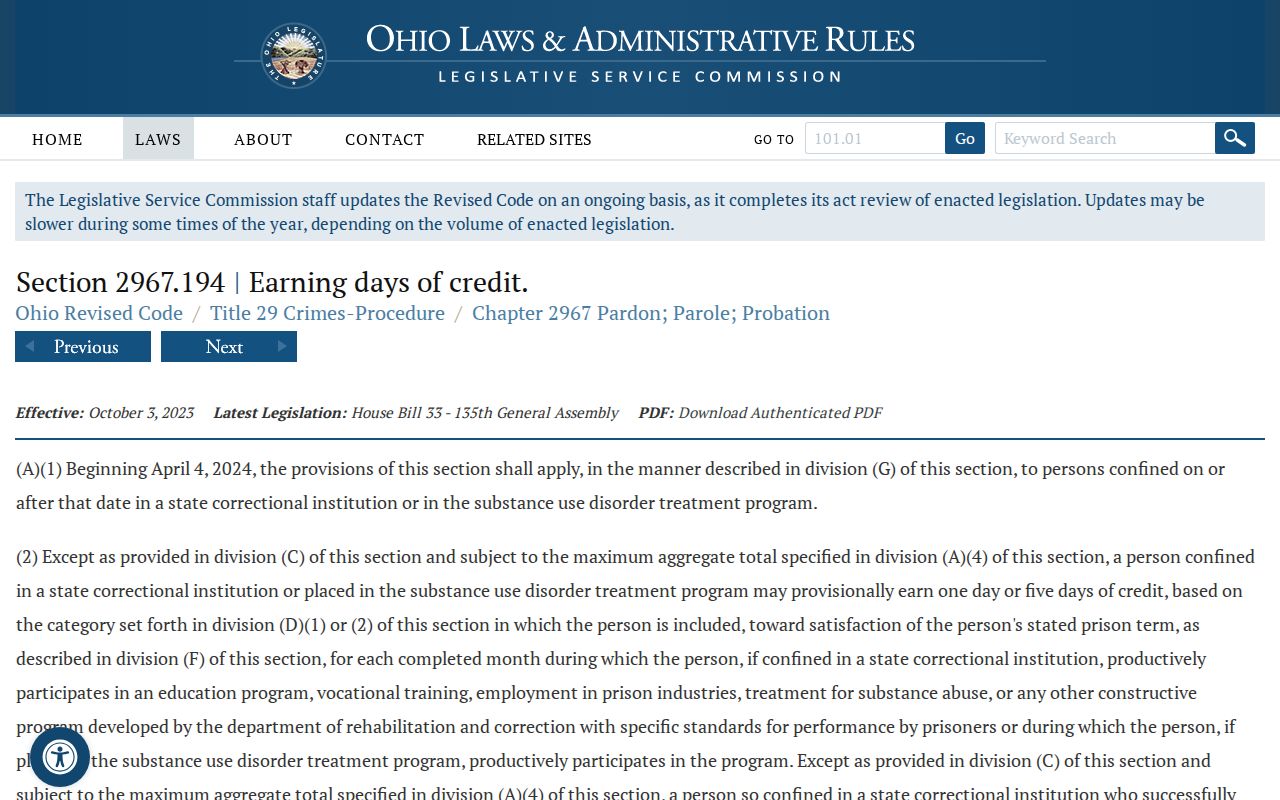
That statutory detail is why the exact person record and sentence must replace a blanket percentage.
Judicial release is also separate from earned credit. Under Ohio law, an eligible state prisoner may be released by the sentencing court. The ODRC record can then show a released or judicial-release status even though the original sentence calculation still carries a later expected date. The court order and current ODRC status reconcile that apparent conflict.
Parole presents a different path. Eligibility depends on the sentence, and not every state prisoner receives a hearing. A Board result may grant, deny, defer, or continue a matter. Even a “paroled” result must be paired with current status and release or supervision detail before it is treated as physical exit.
Clermont Jail Release Calculations
ODRC’s state-prison earned-credit formula should not be applied to a Clermont County Jail sentence. Read the specific sentencing entry, jail-time credit, consecutive or concurrent structure, other holds, and later orders. Then ask jail records for any maintained calculated release information. A bond amount on the current roster is not proof that bond was posted or release completed.
No Clermont-specific published county good-time rule or weekend-release practice was found. There is no sound basis for assuming a Friday adjustment, fixed gate hour, or automatic weekend process. County timing must be confirmed from the court and jail for that booking episode.
For a local sentence, court dates can also be mistaken for release dates. A scheduled hearing may change, and a roster date can be stale or placeholder-like. Use the clerk chronology for the operative order. Then use VINE or the jail for custody status. One source predicts or authorizes; the other confirms processing.
When a sheriff response arrives, preserve its field names. “Released,” “transferred,” “bond,” “court ordered,” and “time served” do not mean the same thing. A timestamp proves an event in the source system, not arrival at a home or completion of every case. If a code is unclear, ask whether an existing code table or policy is available.
Transfer must also stay separate from freedom. If the person vanishes from the Clermont roster and appears in ODRC as Incarcerated, the county departure was a move into state custody. A later APA Supervision, Judicial Release/Released status, or documented discharge is needed before describing state-prison release.
The reverse conflict can occur when a court orders release but the roster still lists the person. Processing, transport, another hold, or a new booking can explain it. The roster refreshes at the top of the hour, but that is not a promise of instant removal. Check VINE, contact the jail, and obtain the release record.
Public Record Search
Sponsored Results