
Clermont Jail Release Destinations
A departure from the Clermont County Jail can end in several places. A court may authorize return to the community on an own-recognizance, ten-percent, cash, professional, or property bond. A person may also leave after dismissal, after serving the ordered time, or when community control begins. Community control is a court-ordered form of supervision in the community. Those paths differ from a move to the Ohio Department of Rehabilitation and Correction, another county, or another agency acting on a holder.
The receiving authority matters. If the Clermont record says “transferred,” the person did leave this jail, but may remain confined. An ODRC record with an Incarcerated status points to state custody, not community release. An outside holder may result in pickup by another county or agency. Ask for the release or disposition code and the receiving authority when the destination is unclear. A release timestamp proves processing in the sheriff’s system; it does not by itself show arrival at a home or the end of every pending case.
Confirm a Clermont Jail Release
Clermont uses a three-part route because the sheriff does not publish a historical released-person list. The current jail roster helps establish whether the person is still listed and supplies a booking number, charge, case number, court, and bond fields. The sheriff says the current list refreshes at the top of each hour. That cadence does not turn it into an hourly archive, and a status conflict can persist while release processing, transport, or another hold is resolved.
- Search the current roster with the person’s full name. Record the booking number, case number, named court, and any holder before the entry leaves the live page.
- Use Ohio VINELink for a recent participating-agency custody status or alert. Match the reporting agency and identifiers, then confirm the update rather than treating an alert as a court ruling.
- Open the matching Municipal Court or Common Pleas Court case. Read the latest bond, dismissal, sentence, warrant, community-control, or transfer entry.
- Request the existing booking-release record from the sheriff when the exact time, release code, or receiving agency matters. Use a narrow date range and booking number when known.
- Check the ODRC Offender Search only when a state transfer or later state-prison release is at issue. An Incarcerated result means the person remains in state custody.
The court docket explains the legal authority, while the sheriff record documents the local custody event. Neither should be forced to answer the other’s job. A VINE release alert can be accurate even while a criminal case stays open. Likewise, a court release order may appear before the jail finishes processing or resolves a second hold. When sources conflict, keep their dates, contact the jail, and request the release record.
Clermont Jail Records Contact
Routine inmate information and formal records requests use different channels. The jail information line answers current facility questions. The public-records process is the route for an existing booking and release record. Clermont County Sheriff accepts requests online, by phone, email, mail, or in person, so a requester does not have to depend on one portal.
Clermont County Jail
4700 East Filager Road
Batavia, OH 45103
Inmate information: 513-732-7540
Sheriff administrative line: 513-732-7500
Sheriff Public Records
Phone: 513-732-7555
Email: sheriffpublicrecords@clermontcountyohio.gov
Hours: weekdays, 8:00 a.m.–4:00 p.m., excluding holidays
Request instructions and channels
Describe the person and one booking episode. Useful identifiers include the full recorded name, date of birth only as needed to distinguish the person, booking number, and a narrow date interval. Ask for the maintained release date and time, release or disposition code, releasing authority, receiving agency, and any holds shown at departure. The request should seek existing records, not ask staff to create a new explanation. Ohio public-record rules may permit redaction or withholding of some material.
Note: NextRequest can submit and track a request, but its archive is not a complete Clermont County Jail release database.
Clermont Jail Custody Profile
The Clermont County Sheriff’s Office operates this adult county jail. Its live population can include matters tied to Municipal Court, Common Pleas Court, occasional Juvenile Court contempt, and outside-agency holders. That mix is why a single court search is not always enough. The court or holder field on the roster should guide the next check, and the same person may have more than one case or hold.
Those sheriff-reported figures show high turnover, but they do not state the number of unique people or a release rate. A current-only roster cannot reconstruct that history. It records useful facts while a person is listed, including booking and bond data, yet it does not show a release reason, destination, recent-release window, or visible booking photo. For a historic local departure, the records request remains the sound documentary route.
The sheriff’s corrections overview shows the facility and explains its corrections role.
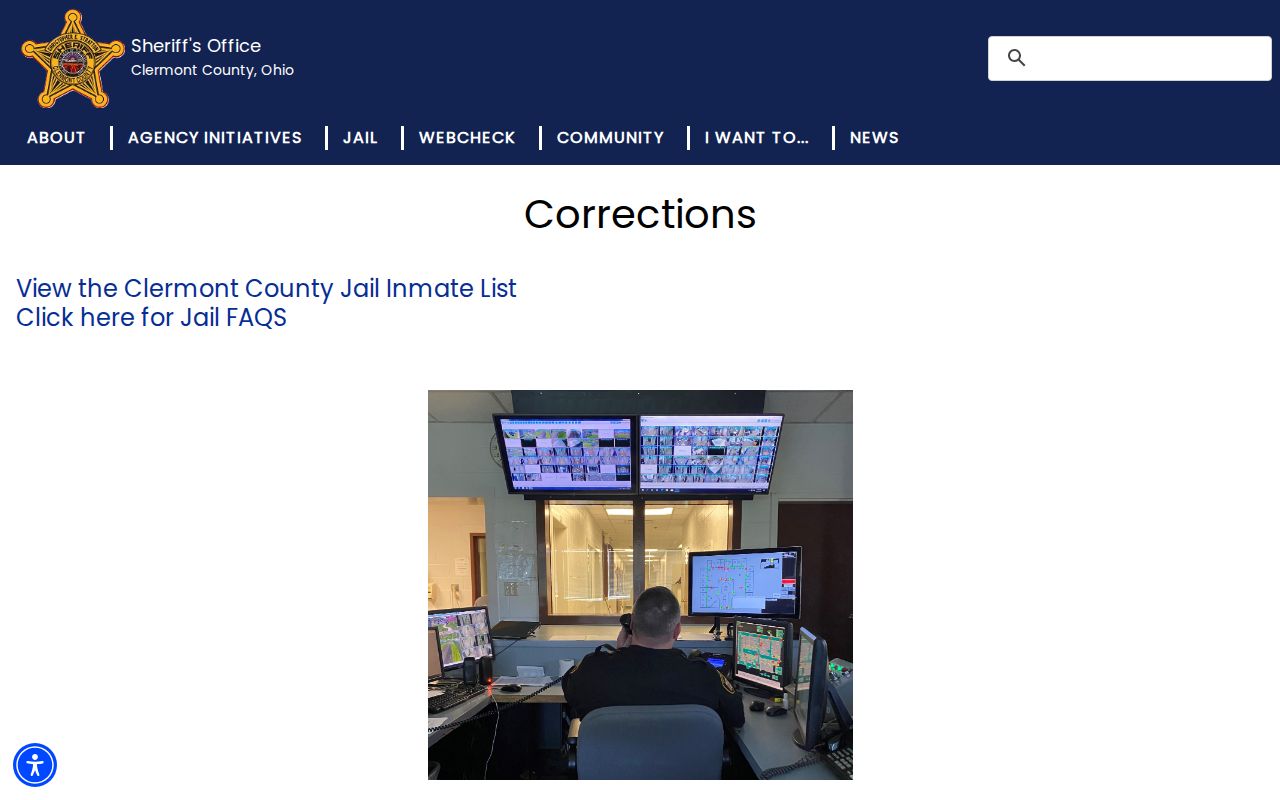
The source view identifies the adult jail context behind the local booking, custody, admissions, and release functions discussed here.
Clermont Jail Expansion History
The jail’s physical development helps explain why facility descriptions can contain several bed counts. A 128-cell maximum-security core opened in 1986. Renovation in 2003 expanded booking and added a 14-bed classification area. A 192-bed north addition opened in 2006. A separate 192-bed south minimum-security section had opened in 1994, was renovated in 2003, and closed in 2006, with possible reopening tied to need and funding.
These dates and figures describe the jail’s structure, not a promise that each section is open or that a given person was held in one wing. The operator’s current information controls. More important for release verification, the sheriff identifies admissions and releases as core functions but does not publish a fixed release time, public exit, family waiting area, weekend practice, or general property-return schedule. Do not infer those logistics from the building history.
Planning a pickup therefore requires direct, current confirmation. A court order may establish the legal basis for departure without fixing the moment when jail staff complete the process. Another warrant, an outside holder, transport, or a new booking can change the apparent outcome. The published material also gives no basis for promising a same-day release, a weekend procedure, or a place where family should wait. Ask the jail about the active booking and follow staff instructions. If exact timing later becomes important, request the maintained release timestamp and code instead of relying on an estimate made before processing ends.
Physical capacity is also distinct from the live roster count. Historic bed figures describe parts of the complex across different years, while the current roster reflects people listed at the time of its refresh. Neither figure proves how many community releases occurred on a day. The sheriff’s annual processing and average-population figures are context for turnover only, and should not be converted into an unofficial release rate.
Clermont Jail Transfer Property
The sheriff’s corrections FAQ gives a narrow rule for people transported to state institutions. With few exceptions, they cannot take personal property with them and may contact someone to collect it. This statement applies to state-institution transport. It should not be recast as a general rule for every person who returns to the community.
A state transfer also changes the correct lookup. Search ODRC after intake, compare the Clermont court case, and read the state status. If ODRC lists the person as Incarcerated, describe the event as transfer from county jail to state custody. Only a later state record showing APA Supervision, Judicial Release or Released, together with the relevant details, supports a state-prison release finding. The Clermont County released-inmate search and record coverage sets out the broader county, state, and federal boundaries.
Read Clermont Release Codes
Agency field names should be preserved when a response arrives. “Released,” “transferred,” “court ordered,” “bond,” and “time served” can lead to different next steps. If an internal abbreviation is unclear, ask whether an existing code table or policy is available. Do not ask the records office to speculate. A transfer code calls for a check of the named receiving agency. A court-ordered code should be paired with the actual docket entry.
- Release
- A departure from this custody system; the destination and authority still need review.
- Transfer
- A move to another custodian, which does not mean freedom in the community.
- Holder
- A notice that another agency may claim custody because of a separate matter.
- Community control
- Court-ordered supervision served in the community instead of confinement under that sentence.
If no record appears online, retry name variants, search by case number, and submit a focused sheriff request. “No online result found” is the safe conclusion until an agency confirms more. Sealed records, spelling, data age, another county, or a different custody system can all affect public results.