
Clermont Parole and Probation
Ohio uses several forms of supervision. The Ohio Adult Parole Authority, part of the Ohio Department of Rehabilitation and Correction, supervises parole, post-release control, and other departmental releases. Clermont County Municipal Court Adult Probation supervises misdemeanor community control. Common Pleas Court may impose felony community control or supervise a person after judicial release. A bond release can include pretrial conditions, but it is not automatically parole or probation.
The source of the order matters. A person can leave Clermont County Jail on bond while the criminal case remains open. Another person can leave an Ohio prison under APA supervision. Both are outside the facility, yet the records and supervising offices differ.
| Supervision | Who orders it | Where to verify |
|---|---|---|
| Parole or post-release control | Ohio law, ODRC, or the Ohio Parole Board | ODRC Offender Search status and assigned APA office |
| Municipal community control | Clermont County Municipal Court | Municipal docket and Adult Probation |
| Felony community control or judicial release | Clermont County Common Pleas Court | Common Pleas docket, then the named supervisor |
| Pretrial bond conditions | The court handling the open case | Current bond order and docket |
These terms are easy to confuse. The definitions below keep each status tied to its legal source.
- Parole
- Conditional release from an eligible prison term under APA oversight.
- Probation or community control
- Court-ordered community supervision instead of, or after, local confinement.
- Post-release control
- Supervision that follows certain Ohio prison terms.
- Discharge
- The formal end of the applicable supervision or sentence obligation.
- Absconder
- A supervised person whom APA has declared a Violator at Large after loss of contact or another alleged violation.
Verify Clermont Post-Release Supervision
Begin with the system that imposed the supervision. The ODRC Offender Search is the public route for state parole, post-release control, judicial release, APA Supervision, and Violators at Large. It does not cover an ordinary misdemeanor probation case. The Municipal and Common Pleas dockets explain court-ordered community control.
- Identify whether the last confinement was Clermont County Jail or an Ohio prison. A transfer from the jail to ODRC is continued custody, not community release.
- For an ODRC case, search by offender number or a name with few added filters. Use County of Commitment = Clermont for a Clermont sentence.
- Read Current Status first. APA Supervision or Judicial Release/Released can support prison exit; Incarcerated means the person remains in state custody.
- Review supervision start and end fields, residential county, and the assigned APA office. Residential County = Clermont applies only to APA or VAL records and is not the same as county of sentence.
- For local community control, open the correct Municipal or Common Pleas docket. Confirm the sentence entry, start date, later violation entries, and termination entry.
- Contact the office shown by the current record. Office assignments can change, so a general regional office should not be assumed.
A status should be read with its date. APA Supervision confirms release from prison under department oversight at the time of the record. It does not prove the sentence is complete or that no other case exists. The broader Clermont County release search explains how the court docket and custody record fit together.
If the name first came from the Clermont jail roster, use its case number and court field to choose the right docket. A bond entry does not prove release, and later absence does not identify parole or probation. The latest court entry can show bond conditions, community control, a prison sentence, or another result. Only then should the matching supervision channel be used.
The ODRC definitions page explains why an expected date can remain on a record whose current status says released. Status, actual release detail, and supervision dates carry more weight than a future expected date viewed alone.
The official ODRC definitions show how the state separates a projected date from an actual supervision status.
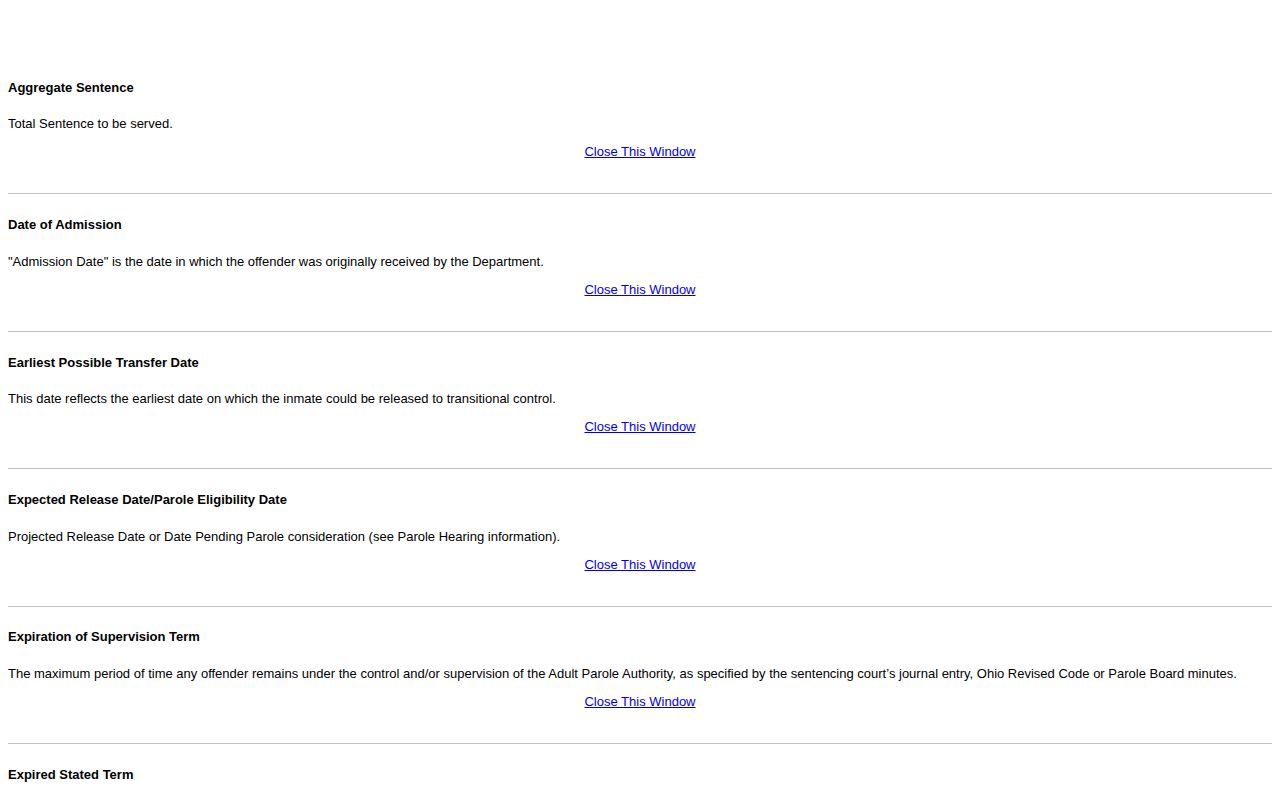
The field definitions help prevent a future sentence date from being mistaken for present incarceration.
Clermont Probation Office Records
For Municipal Court community control, Clermont County Adult Probation provides a narrow public verification route. Its FAQ says supervision can last up to five years. Staff may disclose the charge and community-control start date. Treatment attendance, drug-use information, address and phone data, presentence investigations, and violation recommendations are not public through that channel. A request should stay within the public scope.
4430 State Route 222
Batavia, OH 45103
Phone: 513-732-8100
Fax: 513-732-8169
The Municipal Adult Probation FAQ is the source for disclosure limits and supervision basics. Common Pleas community control must be checked in the felony docket and through the office named in that case. For APA matters, use the assigned office displayed in the ODRC detail rather than treating Municipal Probation as a substitute.
The official probation FAQ illustrates why local verification is case-specific and why protected details should not be requested.
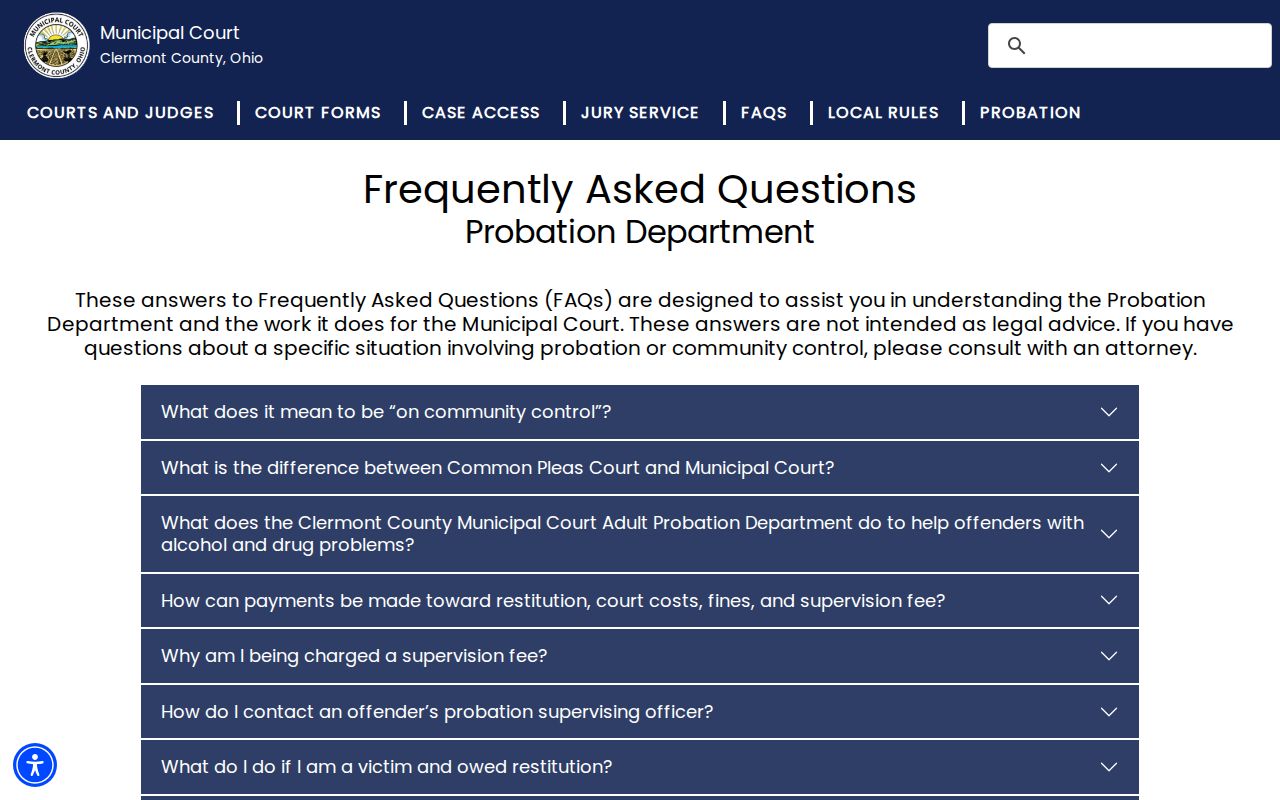
That local source confirms the limited facts available from Municipal Adult Probation.
Clermont Supervision Conditions and Violations
Conditions depend on the order and supervision type. They may require reporting, compliance with court terms, or other case-specific conduct. The operative conditions come from the sentencing entry, APA record, or supervision paperwork. A VINE custody alert may show an arrest or transfer, but VINE is not the supervision plan and does not decide whether a violation occurred.
An alleged violation may produce a court filing, APA action, warrant, or new custody episode. Do not infer a violation merely because a person no longer appears at a recorded address. ODRC warns that residential information can be the last address on file, especially for a person listed as a Violator at Large.
Ohio public-records law also has limits. ORC 149.43 recognizes exemptions that include some probation and parole proceeding records. ODRC records have added limits under ORC 5120.21, while approved release and supervision information may still be public. A lawful redaction does not mean that supervision never existed.
Note: A custody alert and an open supervision record can both be accurate because release does not end the underlying case or sentence.
Clermont Supervision and Final Discharge
Physical release, supervision end, and final discharge are separate dates. An ODRC detail can show when APA supervision started and when it is scheduled to end. A court docket may later record termination of community control. Final discharge is the formal sentence or supervision milestone and should not be replaced with the earlier jail gate time.
When dates conflict, preserve each field name. “Supervision Start Date” is strong evidence of state-prison exit when it matches status. “Supervision End” is not the prison release date. A future Expected Release Date/Parole Eligibility Date may remain in the sentence calculation after judicial release. The sentencing docket and ODRC detail explain different parts of the record.
For a durable state record, begin with the public search and request only specific releasable information if needed. OAC 5120-9-49 treats legally required Parole Board and APA determinations, orders, and minutes as public records subject to its rules. Identify the person, offender number, and relevant action instead of asking for a full confidential inmate file.
Clermont CASC Alternative Path
The Community Alternative Sentencing Center sits on the Clermont County Jail campus, but it is not a jail or a parole database. CASC serves eligible people connected to Municipal Court through treatment, medication-assisted treatment, medical-care links, peer coaching, and recovery support. Participation is a court-linked alternative path, not proof that a person was paroled from Ohio prison.
Eligibility is case-specific. Questions should go through the person’s legal representative or Clermont County CASC at 513-735-8100. Its role must remain distinct from Municipal Adult Probation, Common Pleas supervision, and APA. A CASC connection alone does not establish the terms or end date of supervision.
Clermont VAL Status Warning
ODRC publishes a statewide Violators at Large list. It can show a photo, full name, offender number, date declared VAL, and offenses. VAL means the Adult Parole Authority has identified a supervision absconder. It is not a current home address, a new jail booking, or proof that the person is physically in Clermont County.
The official warning is direct: the public should not try to apprehend anyone. Emergencies belong with 911 or local law enforcement. Officers must verify a warrant through LEADS or NCIC before arrest. ODRC accepts fugitive information at 614-752-1114 or Fugitive.Val@odrc.state.oh.us, but the public record should not be turned into a personal-contact plan.
A VAL search should begin with the offender number when known. Names can collide, and the photograph is only one matching clue. Compare the ODRC number, declared date, and listed offenses. Never treat the last residential county or ZIP as the person’s current position. ODRC says that address data is last recorded information and may be especially unreliable for an absconder.
If the goal is to learn whether supervision resumed or ended, return to the current ODRC detail and the sentencing docket. A declared VAL date is not a new booking date. A later jail roster entry may show a new custody episode, but only the jail and court record explain why that episode began. Each source should keep its own date and label.
The statewide VAL page displays both public identification fields and the safety warning that governs their use.
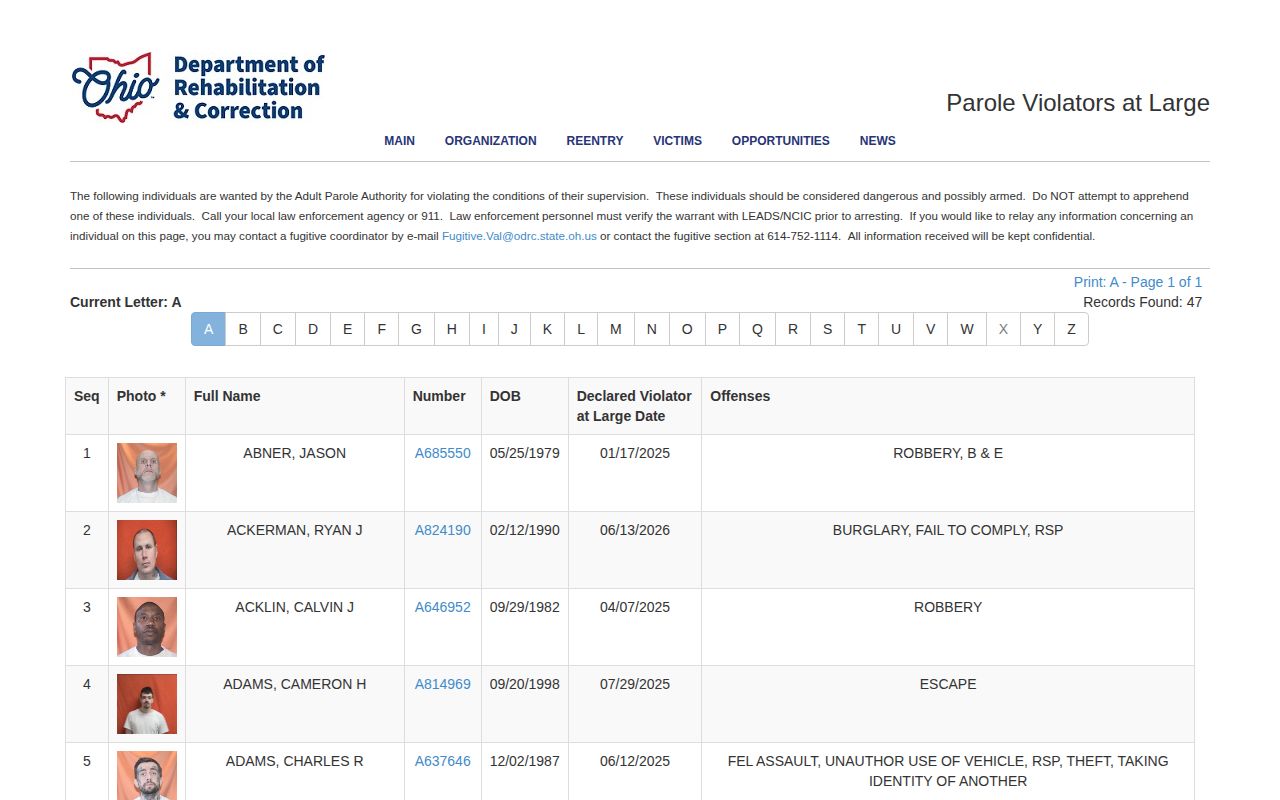
Its declared date marks APA action, not a verified present location or a fresh custody date.
Public Record Search
Sponsored Results